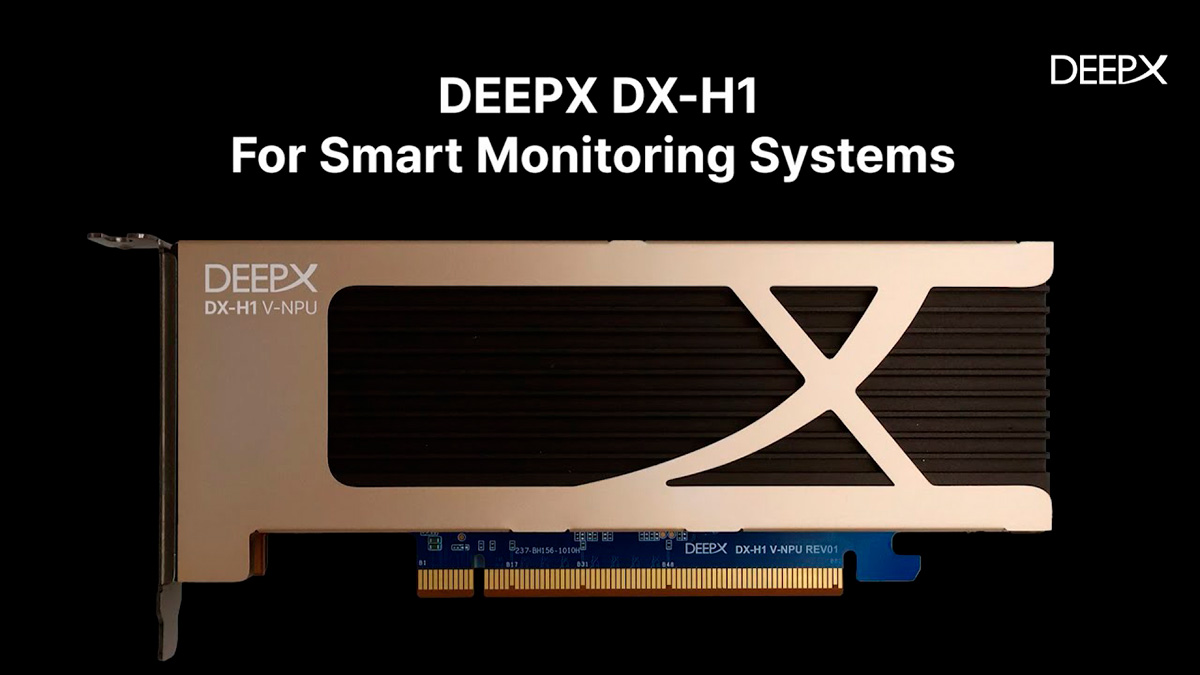
South Korean chipmaker DEEPX has officially entered the server hardware race, unveiling its flagship inference solution — DX-H1. At a presentation held a week ago (December 8), the company positioned the new product not merely as an alternative, but as a technological response to the “energy crisis” in data centers caused by the dominance of power-hungry GPUs.
The announcement sparked strong interest among system integrators — and here’s why.
Technical Core: What Is DX-H1?
Unlike general-purpose GPUs (such as NVIDIA A100/H100), which were originally designed for graphics and HPC, the DX-H1 chip is a specialized V-NPU (Vision Neural Processing Unit).
- All-in-One Architecture: The main bottleneck in modern video analytics systems is data movement. Video must be decoded (CPU), transferred over the bus (PCIe), and processed (GPU). DX-H1 combines the video codec and neural processor on a single die.
- Energy Efficiency: The stated power consumption of a single card is just 30 W. By comparison, a typical server-grade GPU consumes 300–700 W.
- Performance: A single DX-H1 card can process more than 100 video streams in real time. The company claims that one server equipped with their chips can replace an entire GPU rack for video surveillance (Smart City) workloads.
Alliance with Ampere Computing
A key part of the announcement was a strategic partnership with Ampere Computing. DEEPX introduced a reference platform that combines its NPU with energy-efficient AmpereOne processors (ARM architecture). This is a direct challenge to the classic x86 + NVIDIA stack. The alliance aims to build servers that do not require complex liquid cooling and can be deployed in standard office racks or at the edge (Edge).
Economics
For businesses (the B2B segment), this announcement is significant from a TCO (Total Cost of Ownership) perspective.
- Claims: DEEPX promises an 82% reduction in capital expenditure on hardware compared to GPU-based solutions of similar performance.
- Reality: Amid power shortages in new data centers (especially in Europe and the US), switching from kilowatt-class GPUs to 30-watt NPUs could become a decisive factor for security system operators and retailers.
Risk Assessment and Skepticism
Despite the impressive “on-paper” figures, the industry is taking a wait-and-see approach.
- Software Stack: NVIDIA’s primary moat is CUDA. DEEPX is promoting its DXNN SDK, which promises easy model conversion from PyTorch and TensorFlow. The product’s success will depend 90% on how seamless this migration is for developers.
- Independent Testing: As of now (15.12.2025), there are no widely available independent benchmarks from labs such as ServeTheHome or Phoronix confirming the claimed inference accuracy (FP16/INT8) under full load across 100 streams.
Summary
The emergence of DEEPX DX-H1 signals a fragmentation of the AI market. The era of “GPUs for everything” is coming to an end. NVIDIA’s position in neural network training remains unshaken, but in inference and video analytics, a real war for efficiency has begun.
What’s Next: The first live demo booths and independent tests are expected to appear at CES 2026 in Las Vegas in three weeks.

 Arabic
  English