We are ready to help you
NVIDIA RTX PRO 6000 Blackwell 2026: Complete guide to the most powerful GPU for AI and visualization
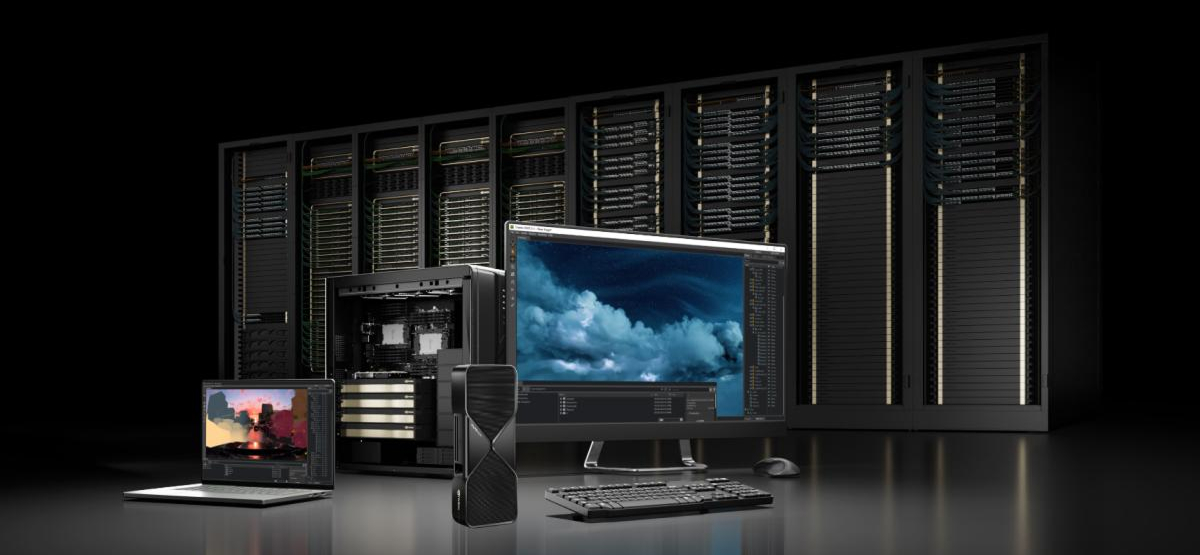
Key takeaways:
- Architectural leap: The move to Blackwell delivers up to 3x gains in AI workloads and 2x in ray tracing compared with the Ada Lovelace generation.
- Record memory: For the first time in the workstation class, 96 GB GDDR7 with ECC support is available, doubling the data volume for on-desk LLM training.
- Native FP4 support: Fifth-generation Tensor Cores run quantized neural networks at extreme speed while reducing memory usage.
- Bandwidth: A 512-bit bus and GDDR7 memory reach 1.79 TB/s — critical for real-time simulations.
- AI ecosystem: Direct integration with NVIDIA Omniverse and Cosmos libraries for digital twins and autonomous agents.
1. What is RTX PRO 6000 Blackwell built for?
Short answer: NVIDIA RTX PRO 6000 Blackwell is built as a “personal AI factory” capable of processing generative models (LLM), video analytics, and photorealistic rendering of ultra-heavy scenes locally. It targets data engineers, robotics developers, and visual effects (M&E) studios.
The card addresses the need for massive video memory (96 GB) that was previously available only in server solutions.
This enables:
- Fine-tuning of Llama-3 or Mistral-class models without quantization.
- Working with Mega Geometry: Rendering scenes with trillions of polygons in Omniverse.
- Video generation: 3.3x faster Text-to-Video tasks versus previous flagships.
2. Blackwell architectural advantages
In 2026, the Blackwell architecture became the foundation for the industrial AI revolution. Unlike gaming solutions, the PRO 6000 version is optimized for 24/7 workloads and computational accuracy.
Fifth-generation Tensor Cores
The main innovation is support for the FP4 (4-bit floating point) format. This packs neural network weights into memory 4x denser than FP16, delivering up to 4000 AI TOPS. Large language model inference is 5x faster.
Fourth-generation RT Cores
The new ray tracing cores support RTX Neural Shaders. Neural networks are now embedded directly in programmable shaders, enabling photorealistic scenes (Path Tracing) in real time even at 8K resolution.
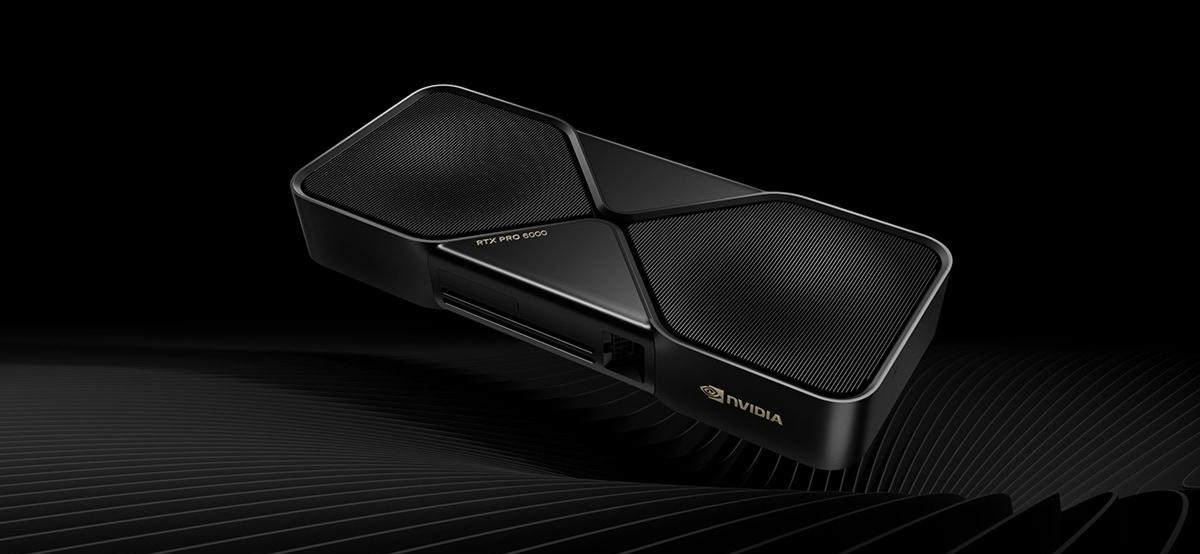
3. Spec comparison: Blackwell vs Ada Lovelace
Below is a comparison table of the 2026 flagship with its predecessor.
| Specification | RTX 6000 Blackwell (2026) | RTX 6000 Ada (2023) |
|---|---|---|
| Architecture | Blackwell | Ada Lovelace |
| Video memory | 96 GB GDDR7 | 48 GB GDDR6 |
| Memory bus | 512-bit | 384-bit |
| Bandwidth | 1792 GB/s | 960 GB/s |
| CUDA cores | 24 064 | 18 176 |
| AI Performance | 4000 TOPS (FP4) | 1457 TFLOPS (Sparsity) |
| Interface | PCIe 5.0 x16 | PCIe 4.0 x16 |
| Power consumption (TDP) | 600 W | 300 W |
4. How is it better than alternatives?
Short answer: Blackwell’s main advantage is the combination of 96 GB memory and native FP4 acceleration, making it 18x more energy-efficient than multi-GPU setups of older cards for AI work.
- Versus consumer cards (RTX 5090/6090): Unlike gaming models, PRO 6000 has ECC memory (error correction), which is critical for scientific computing where a single bit error can crash a multi-day simulation.
- Versus the previous generation: Doubling memory (48 GB -> 96 GB) removes the bottleneck for long context windows (32k/64k tokens) in LLM.
- Cooling system: Double Flow Through technology efficiently dissipates 600 W in a standard dual-slot form factor, allowing up to 4 cards in one workstation.
5. Technical specs and power consumption
To integrate RTX PRO 6000 Blackwell into current pipelines, consider the higher power requirements:
- Power connector: 1x 16-pin (PCIe CEM5).
- Recommended PSU: At least 1200 W for a single-card system.
- Video outputs: 4x DisplayPort 2.1b (supports two 8K monitors at 120 Hz).
“Blackwell is not just a GPU update — it is the engine of a new industrial revolution, bringing data center power to the engineer’s desktop”
Still have questions? We have prepared answers.
-
Can RTX PRO 6000 Blackwell be used for gaming?
Technically yes — it supports DirectX 12 Ultimate and Vulkan 1.4. However, drivers optimized for professional software and a $8565 price make it impractical.
-
Does the card support NVLink?
No. In the Blackwell workstation generation, the focus is on PCIe 5.0. Combining multiple GPUs uses virtualization via the NVIDIA AI Enterprise software stack.
-
How much faster is rendering compared with RTX 6000 Ada?
In heavy-geometry tasks (Mega Geometry) with neural shaders, speed improves up to 2x thanks to updated RT cores.
-
How much memory is available for a single neural network in FP4 mode?
With 96 GB and 4-bit quantization (FP4), you can load a model of up to 150–170 billion parameters on one card while leaving room for context.

 Arabic
  English